How to Read Food Labels & Avoid Ultra-Processed Foods (UPF)
Listen on your favorite podcast platform:
Spotify | Apple Podcasts | YouTube | IHeartRadio | Amazon Music
Have you ever stood in the grocery store aisle, looking at a "healthy" product and wondering if it’s actually good for you? You aren't alone—food labels are often designed to create more confusion than clarity. In this episode of the Foundational Health Podcast, Dr. Kevin Schultz cuts through the marketing noise to show you how to read food labels simply, quickly, and confidently.
Learn why the front of the package is designed to sell you a feeling, while the back tells the truth—if you know what to look for. Dr. Kevin exposes the reality of Ultra-Processed Foods (UPF), which now make up 73% of the U.S. food supply. We dive deep into the "Evil 8" seed oils, the 61 different names for sugar, and the truth behind unregulated buzzwords like "natural" and "farm fresh". As you look to make healthier nutrition choices for your family, this episode gives you to the tools necessary to grocery shop with confidence!
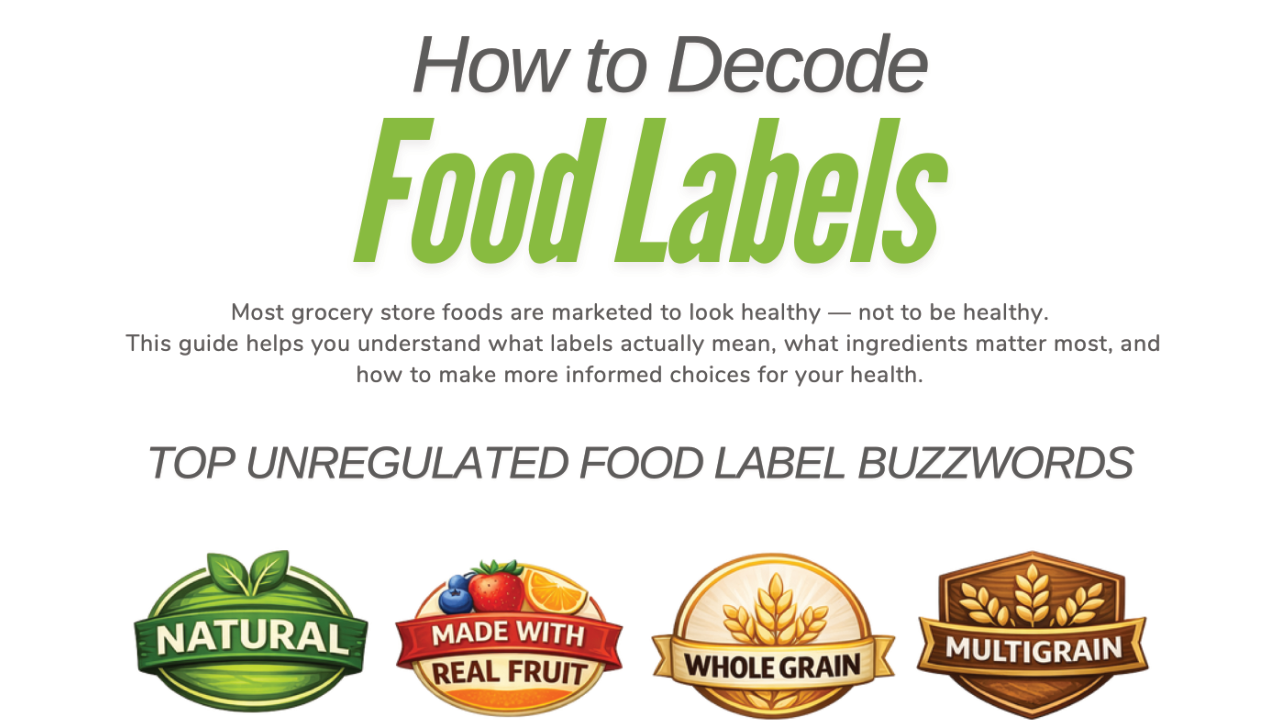
Check out Dr. Kevin’s Food Label Guide!
A quick resource for decoding food labels and making informed, healthy decisions at the grocery store.
A Guide to Decoding Food Labels and Reclaiming Your Health
By: Dr. Kevin Schultz & Colton Ward
Walking through a modern grocery store can feel like navigating a minefield of marketing claims. Words like "Natural," "Heart Healthy," and "Multi-Grain" jump off the shelves, promising health in every bite. However, as Dr. Kevin Schultz explains in the latest Foundational Health Podcast, these terms are often unregulated and designed to sell a feeling rather than provide nutritional facts.
Currently, 73% of the U.S. food supply is ultra-processed (UPF)—man-made substances that are factory-engineered for long shelf life but linked to obesity, heart disease, and a lower quality of life. To protect your health, you must learn to look past the front-of-package "buzzwords" and find the truth hidden on the back.
The Anatomy of an Ultra-Processed Food
To understand why these labels matter, look at the process used to create common items like breakfast cereal. It begins with cheap, pesticide-sprayed commodity crops (often GMO). These grains are stripped of fiber, minerals, and vitamins using high heat, pressure, and chemicals.
During "fortification," synthetic vitamins are added back in to replace the natural nutrients that were destroyed. Finally, the product is coated in sugars, oils, and dyes to ensure it tastes good and lasts on the shelf forever. The result is an inflammatory, man-made product that is far removed from real food.

Tricks to Reading Food Labels
Unfortunately, food companies use all sorts of misleading packaging and labelling tricks to sell you their products. Nowadays, with the rise in health-conscious consumers, many of these tricks are designed to make a product look healthier than it is. We’ve done the research so you don’t have to. Here are some tricks for seeing through marketing lies and finding truly healthy foods for you and your family.
The Buzzword Trap: What Labels Really Mean
Marketing teams use specific "unregulated" words because they know they influence buying habits without requiring legal proof. Here are some of the most common offenders:
Natural: This is the most common buzzword. It often simply means the product started with a natural raw material, but it can still be heavily processed, chemically treated, and stripped of nutrients.
Made with Real Fruit: This can legally be used even if the product contains a microscopic amount of fruit or just fruit juice with all the fiber and beneficial nutrients removed.
Whole Grain: This claim can appear in large letters even if the product is primarily made of refined, inflammatory flour. The grain may have started "whole," but the refining process destroys its health benefits.
Multigrain: While it sounds healthy, "multigrain" simply means the product contains more than one type of grain. It does not mean those grains are whole, unrefined, or in their original, healthy form.
No Added Sugar: This is a major legal loophole. Companies can still add high amounts of sugar via fruit juice concentrates and other "natural" syrups while claiming no sugar was "added".
Low Fat: This label often signals a health disaster. When fat is removed, flavor is lost; manufacturers typically replace that fat with added sugars and refined carbohydrates to make the product palatable.
Farm Fresh: This is one of the most misleading terms because it has zero legal meaning. A product doesn't even have to come from a farm to use this label; it is purely designed to make a product seem healthy and natural.
Sugar-Free: While it may not contain cane sugar, "sugar-free" products often contain artificial sweeteners like aspartame, which can be neurotoxic and harmful to your overall nervous system.
Heart Healthy: Often, this stamp is simply bought and paid for from organizations like the American Heart Association, requiring no independent scientific proof of the specific product's benefits.
Reading the "Truth" on the Back
When you turn the package over, the ingredient list is your most powerful tool. Ingredients are listed by weight, meaning the first ingredient is what the product contains the most of.
The Sugar Trick: Companies often use multiple types of sugar (there are 61 legal names!) so that "sugar" doesn't appear as the #1 ingredient.
The "Evil 8" Seed Oils: Watch out for inflammatory oils like corn, canola, cottonseed, soybean, safflower, sunflower, grapeseed, and rice bran.
The Trans-Fat Loophole: Companies can label a product as having "zero trans fats" if the amount per serving is low enough. They often simply shrink the serving size to meet this legal loophole.
Choosing High-Quality Whole Foods
When moving away from processed foods, labels still matter for meat, eggs, and dairy.
Beef: Look for "100% Grass-Fed" or "Grass-Fed and Finished". Standard "grass-fed" labels can be misleading if the cattle were finished on GMO grains for the last months of their lives.
Eggs: The gold standard is "Pasture-Raised". "Cage-free" and "Free-range" labels often still mean the chickens live in crowded, indoor conditions.
Dairy: Aim for the "Big Three": Organic, 100% Grass-Fed, and Full Fat. For those with sensitivities, A2 casein dairy is often much easier to digest than standard A1 casein milk.
Check Out Dr. Kevin’s Meat & Dairy Label Guide!
Learn how to pick out high-quality meat and dairy to support your nutrition and overall health.
Actionable Steps for Your Next Grocery Trip
Building a foundation for health doesn't happen overnight. Dr. Kevin recommends the 90/10 Rule: aim to get 90% of your daily food from whole, single-ingredient sources and limit processed foods to just 10%.
The easiest way to eat healthy? Buy more foods that don't even have a label—fruits, vegetables, and local meats. By educating yourself and your family, you can stop being a victim of marketing and start making confident choices for your long-term wellness.
FAQ: Decoding Food Labels
What are ultra-processed foods (UPF)?
Ultra-processed foods are factory-made products built from re-engineered ingredients like emulsifiers, protein isolates, and flavor additives. They are designed for a long shelf life but are linked to chronic health issues like obesity and heart disease.
Is "Natural" on a food label the same as "Organic"?
No. "Organic" has specific legal requirements regarding feed and pesticide use, while "Natural" is largely unregulated. A "natural" product can still be heavily processed and treated with chemicals.
How do companies hide sugar in ingredient lists?
Companies use multiple names for sugar—such as dextrose, sucrose, and fruit juice concentrates—to distribute the weight across the ingredient list. This prevents "sugar" from appearing as the first ingredient, even if the total sugar content is high.
What are the "Evil 8" seed oils I should avoid?
The eight most inflammatory seed oils commonly found in processed foods are corn, canola, cottonseed, soybean, safflower, sunflower, grapeseed, and rice bran.
What is the best type of egg to buy?
Pasture-raised eggs are the highest quality, as the hens have access to outdoor space and eat a natural diet of grass and bugs.
Why do some "low-fat" foods seem unhealthy?
When manufacturers remove fat, they often add extra sugars and refined carbohydrates to make up for the lost flavor.